
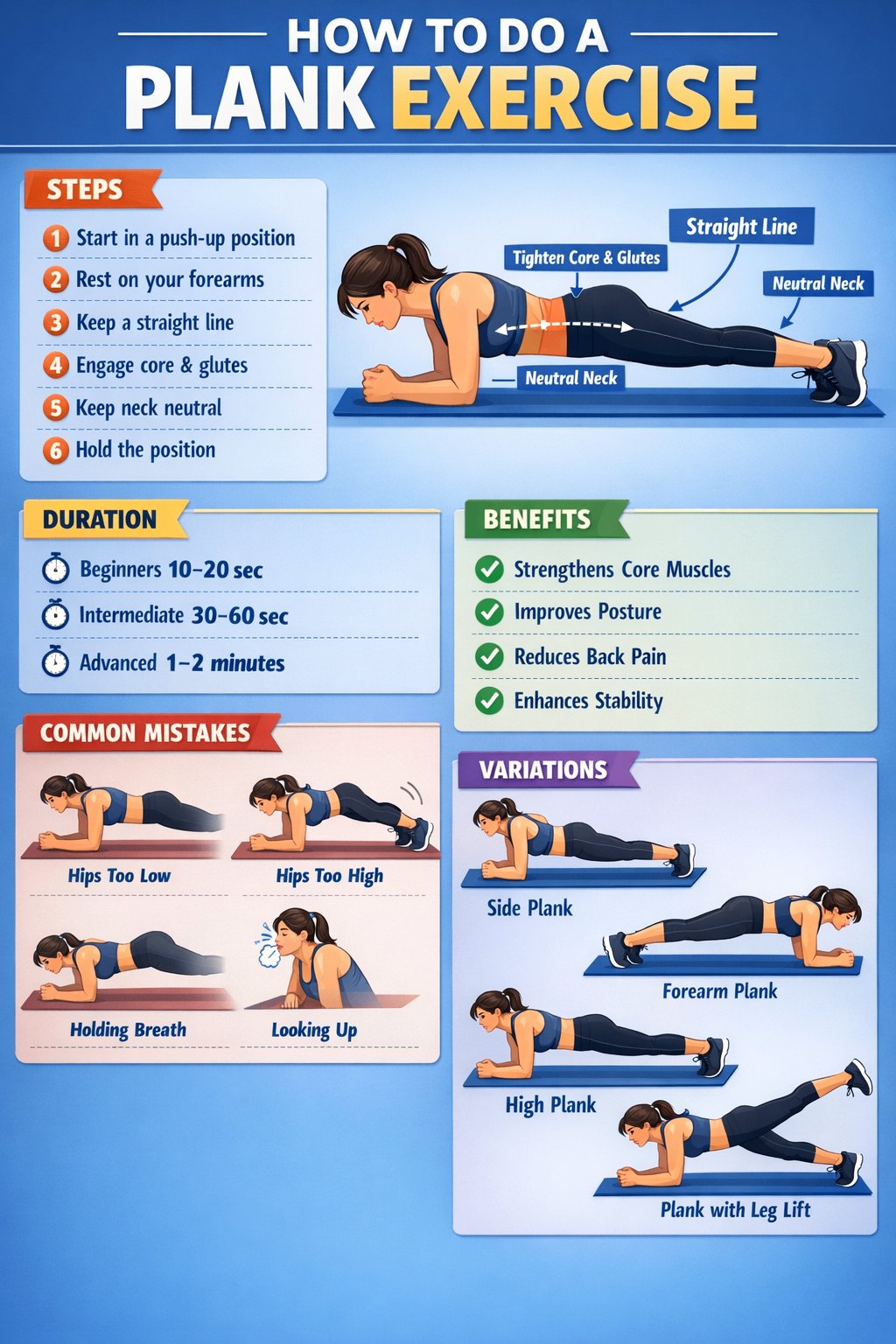
The plank exercise is a simple yet powerful workout that strengthens the core muscles, improves posture, and increases body stability. It also helps build endurance in the abdomen, back, shoulders, and legs without requiring any equipment
How to do a plank correctly
Start in a push-up position
Bend your elbows and rest on your forearms
Keep your body in a straight line from head to heels
Tighten your core (abdomen), glutes #, and thighs
Keep your neck neutral (look down, not forward)
Hold the position without letting your hips drop or rise
Duration
Beginners: 10–20 seconds
Intermediate: 30–60 seconds
Advanced: 1–2 minutes or more
Benefits
Strengthens core muscles # (abs, back, pelvis)
Improves posture
Reduces the risk of back pain
Enhances balance and stability
Supports better performance in daily activities
Common mistakes
Letting hips sag (causes back strain)
Raising hips too high
Holding breath (always breathe normally)
Looking forward (strain on neck)
Variations
Side plank
Forearm plank
High plank (on hands)
Plank with leg lift
key:
1. The core muscles are a complex network of 29 muscle pairs forming a stabilizing "muscular box" that supports the spine, pelvis, and torso. It acts as a central anchor, transferring force between your upper and lower body and keeping you balanced. #
2. The torso includes the chest, abdomen, pelvis, and back, and houses most of the body's vital organs, such as the heart and lungs. #
3. The glutes are a group of three major muscles that make up the buttocks: the gluteus maximus, gluteus medius, and gluteus minimus. #