
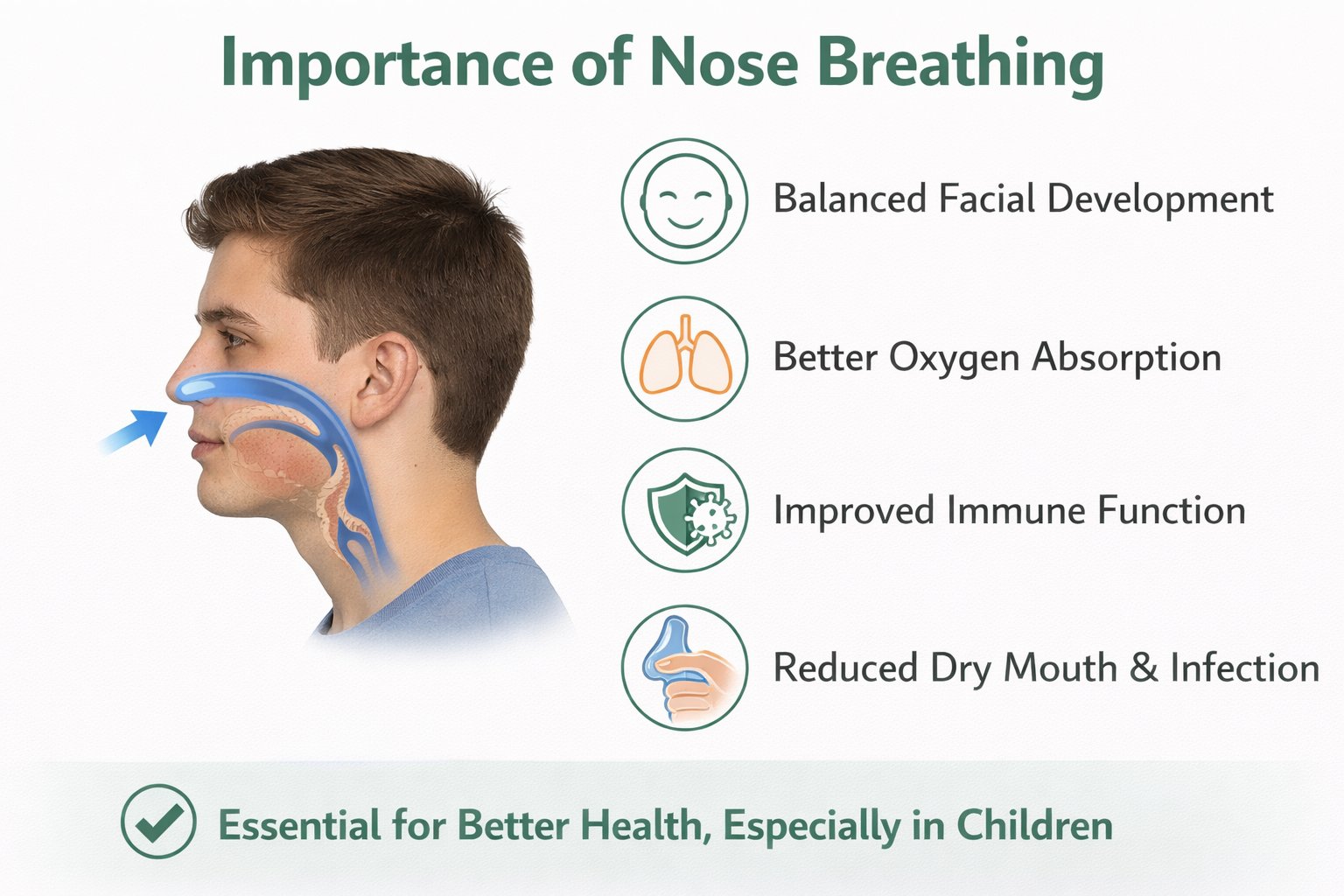
Nose breathing is more important than mouth breathing, which people realize because it affects oxygen delivery, sleep quality, and even long-term health.
Nose breathing really shows its advantages: How nose breathing helps release oxygen efficiently
The key player is a molecule called nitric oxide (NO).
1. Nitric Oxide Production in the Nose
When you breathe through your nose, your sinuses # produce Nitric oxide.
This gas mixes with the air you inhale
It travels down into your lungs
2. Improves Oxygen Exchange in Lungs #
Nitric oxide helps:
Dilate (widen) blood vessels in the lungs
Improve blood flow to air sacs (alveoli) #
This means oxygen can move from the lungs → blood more efficiently
3. Helps Oxygen Reach Tissues (Bohr Effect) #
There’s also an important mechanism called the Bohr effect:
Nose breathing is slower and more controlled
This maintains slightly higher CO₂ levels in the blood
Higher CO₂ signals hemoglobin to release oxygen to tissues
So oxygen is not just carried—it is delivered where needed
4. Mouth Breathing vs Nose Breathing
Mouth breathing is usually fast and shallow
This can lower CO₂ too much
Result: oxygen stays stuck to hemoglobin # instead of being released
Simple Analogy
Think of hemoglobin like a delivery truck:
Nose breathing: Opens the doors → oxygen gets delivered to cells
Mouth breathing: Doors stay partly closed → oxygen stays in the “truck” (lungs/blood) less efficiently
Massage
Nose breathing improves oxygen efficiency by:
Adding nitric oxide → better lung function
Maintaining CO₂ balance → better oxygen release (Bohr effect)
Promoting slow, deep breathing → optimal gas exchange
Key:
1. Sinuses: It most commonly refers to the paranasal sinuses (air-filled spaces in the skull). #
2. Oxygen Exchange in Lungs: When we inhale, air travels down our windpipe and into millions of tiny, balloon-like air sacs in our lungs called alveoli. These sacs are wrapped in a dense web of microscopic blood vessels known as capillaries. The walls separating the alveoli and capillaries are incredibly thin. This allows gases to move freely between the air and blood in a passive process called diffusion. #
3. Hemoglobin is an iron-rich protein in red blood cells that carries oxygen from our lungs to the rest of our body and helps transport carbon dioxide back to the lungs. It gives blood its red color and is essential for powering cells and providing energy. #