
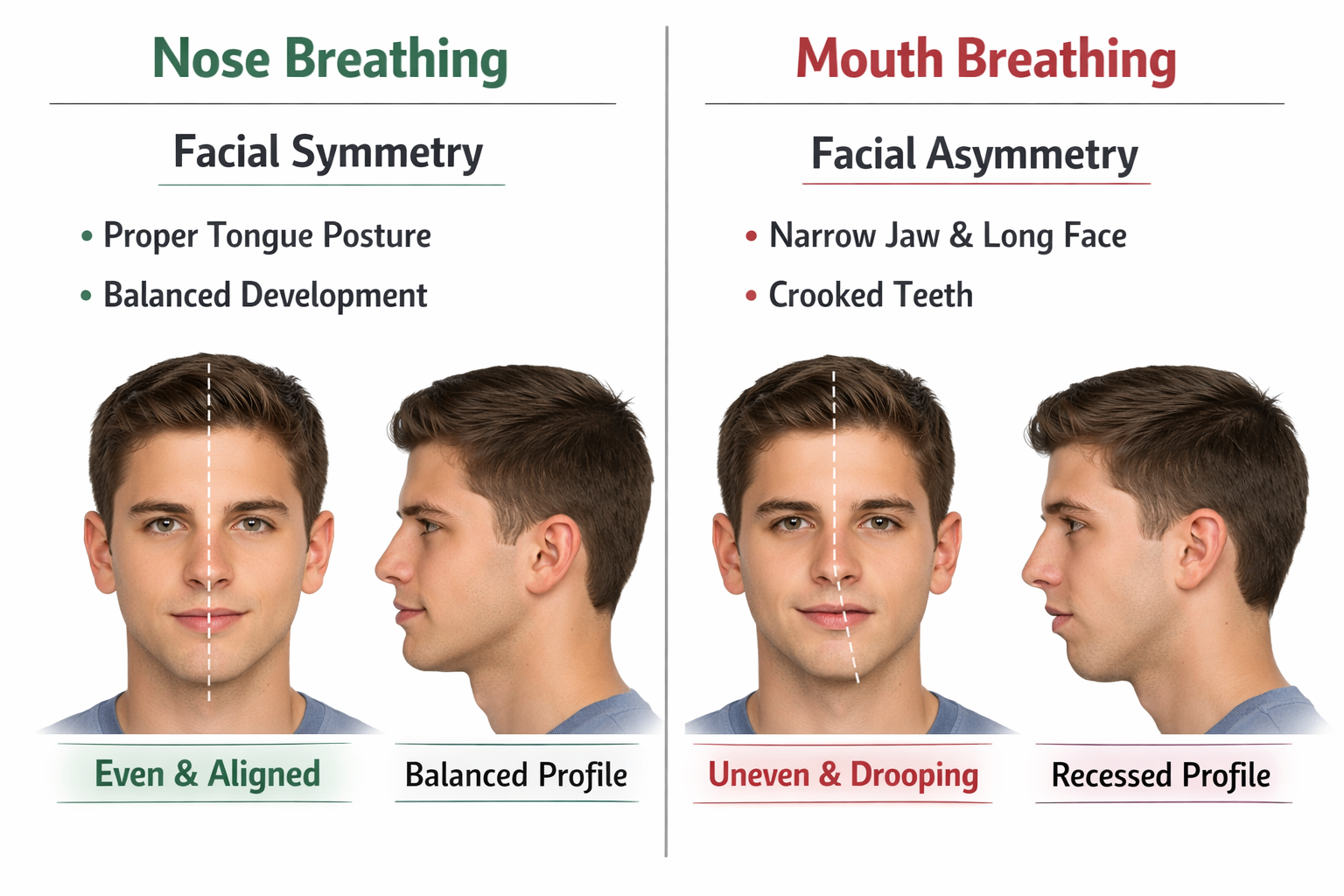
The idea that nose breathing improves facial symmetry has some truth—but it needs to be understood correctly.
How nose breathing can influence your face
When you breathe through your nose consistently:
Proper tongue posture
Your tongue naturally rests on the roof of your mouth (palate). This helps guide the upper jaw to grow evenly.Balanced muscle use
Facial muscles (cheeks, lips, jaw) work in harmony, reducing uneven pull on one side.Better jaw development (especially in children)
In growing individuals, this supports a well-shaped jaw and can indirectly promote symmetry.
What happens with mouth breathing?
Chronic mouth breathing can lead to:
Narrow upper jaw
Elongated face (“long face syndrome”)
Crooked teeth
Slight asymmetry over time
This is commonly discussed in fields like Orthodontics and Craniofacial development.
Important reality check
Nose breathing does NOT suddenly fix facial asymmetry in adults
Major facial symmetry is influenced by:
Genetics
Growth during childhood
Habits over many years
So, for adults, nose breathing is mainly:
Improves posture, oxygenation, and health
Helps prevent further imbalance, rather than reshaping the face, since facial bones are already fully developed.
Where it matters most
In children and adolescents, nose breathing is very important
Early correction (if mouth breathing exists) can significantly improve facial development
Message:
✔ Nose breathing supports healthy, balanced facial development
It is not a quick cosmetic fix, especially for adults
It’s still very important for overall health and appearance
This content is for educational purposes only and does not replace professional medical advice.
Comments (0)
Join the conversation
Sign in to share your thoughts with the community.
No comments yet. Be the first to share your thoughts!