
This article is intended for educational purposes only and does not constitute medical advice, diagnosis, or treatment. Always consult a qualified healthcare professional before making any health decisions.
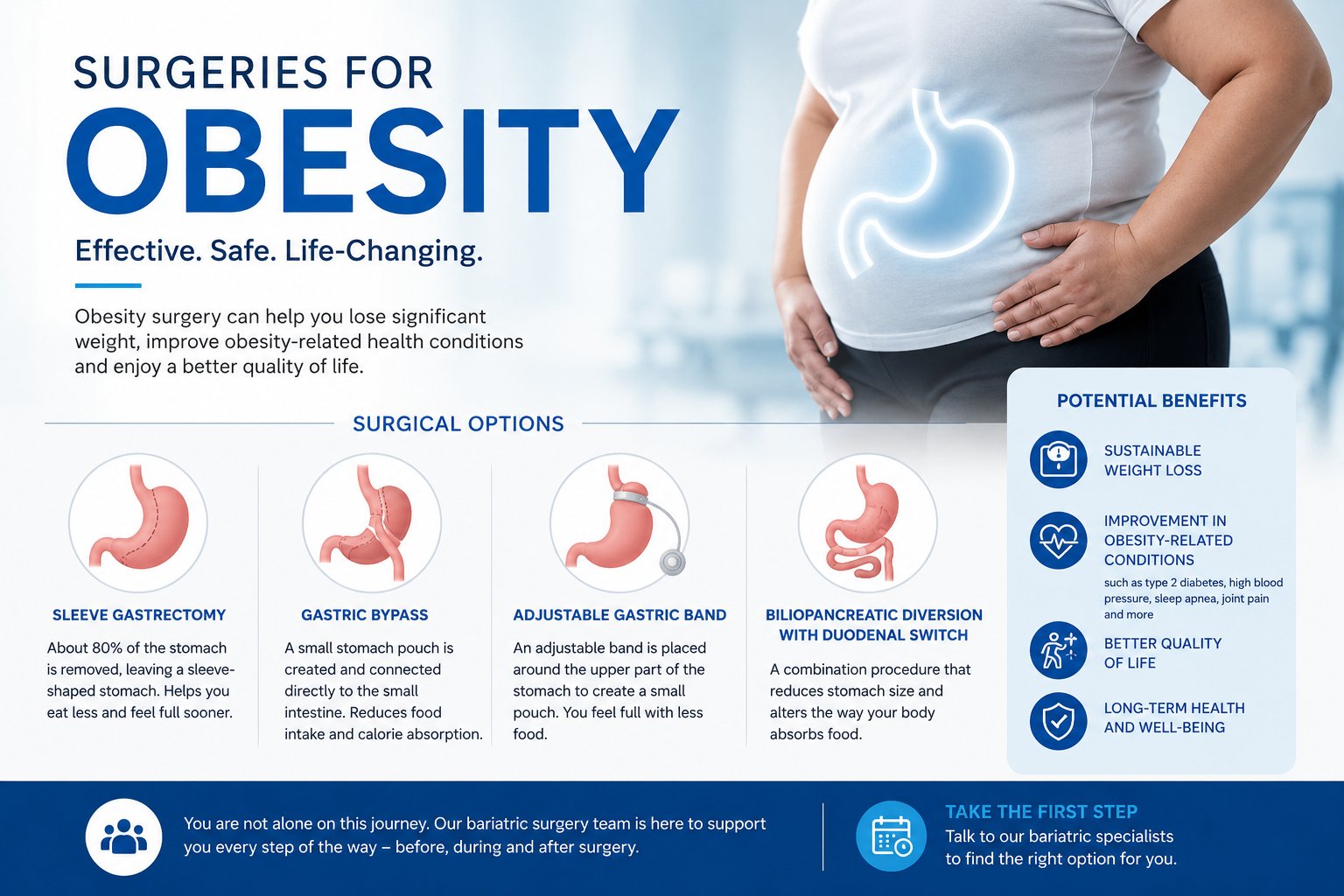
Surgical Treatment for Obesity (Bariatric Surgery)
Bariatric surgery refers to a group of surgical procedures performed to help people with severe obesity lose weight by altering the digestive system.
When Is It Done?
Surgery is considered when other methods (diet, exercise, medication) have failed.
Requirements for this surgery:
Age typically 18–65 (can be done in selected adolescents and older adults)
Failed attempts at non-surgical weight loss for at least 6 months
No uncontrolled psychiatric illness or active substance abuse
Willing to commit to lifelong dietary and lifestyle changes
Medically fit enough to tolerate surgery
Types of Bariatric Surgery
1. Sleeve Gastrectomy (Most Common)
About 75–80% of the stomach is removed, leaving a banana-shaped sleeve
Reduces hunger hormone (ghrelin)
Expected weight loss: 60–70% of excess weight
2. Roux-en-Y Gastric Bypass (Gold Standard)
A small stomach pouch is created and connected directly to the small intestine
Both restrictive and malabsorptive. #
Expected weight loss: 70–80% of excess weight
3. Adjustable Gastric Band (Less Common Now)
A silicone band is placed around the upper stomach
Reversible but less effective long-term
Expected weight loss: 40–50% of excess weight
4. Biliopancreatic Diversion with Duodenal Switch (BPD/DS)
Most aggressive procedure; reserved for BMI > 50
Highest weight loss, but also the highest risk of nutritional deficiencies
Is It Safe?
Yes — Bariatric surgery is generally considered safe, especially when performed by experienced surgeons in accredited centers. However, like all major surgeries, it carries risks.
Benefits:
Significant and sustained weight loss
Remission or improvement of Type 2 diabetes (in up to 80% of cases)
Improvement in hypertension, sleep apnea, joint pain, PCOS (polycystic ovarian syndrome) #
Reduced risk of heart disease and certain cancers
Improved quality of life and life expectancy
Short-Term Risks:
Bleeding or infection
Blood clots (Deep Vein Thrombosis/pulmonary embolism). #
Anastomotic leak # (in bypass procedures) — serious but rare (~1%)
Adverse reaction to anesthesia. #
Mortality rate: # ~0.1–0.3% (comparable to gallbladder removal)
Long-Term Risks:
Nutritional deficiencies — Iron, B12, Vitamin D, Calcium (require lifelong supplements)
Dumping syndrome # (especially after gastric bypass)
Acid reflux # (can worsen after sleeve)
Weight regain if lifestyle is not maintained
Need for revision surgery in some cases (~5–10%)
Gallstones # after rapid weight loss
Bariatric surgery is a powerful tool, not a cure by itself. Its success depends heavily on lifelong commitment to dietary changes, physical activity, regular follow-up, and vitamin supplementation. When done at a qualified center, it is safe and highly effective for carefully selected patients.
A multidisciplinary evaluation (surgeon, dietitian, psychologist, and endocrinologist) is essential before proceeding with the surgery.
Key:
Roux-en-Y Gastric Bypass
1. RESTRICTIVE Component
"You can eat LESS.”
In a normal stomach, capacity is about 1–1.5 litres.
In Gastric Bypass, a tiny pouch (~30 ml, the size of an egg) is created from the upper part of the stomach.
What happens?
You feel full very quickly after just a few bites
You physically cannot eat large portions
The rest of the stomach (called the remnant stomach) is completely bypassed — it no longer receives food
This alone significantly reduces calorie intake
2. MALABSORPTIVE Component
"Your body ABSORBS fewer calories."
Malabsorption = the small intestine absorbs fewer nutrients and calories than normal.
After Roux-en-Y Bypass:
Food skips the duodenum (the main absorption zone)
Digestive enzymes and bile meet food later than normal
This shortens the effective absorption length of the intestine
Result → fewer calories, fats, and nutrients are absorbed
3. Polycystic ovarian syndrome: a common hormonal disorder where the ovaries produce an excess of male hormones (androgens). This imbalance disrupts the menstrual cycle, often preventing ovulation and causing small cysts to form on the ovaries. #
4. Deep Vein Thrombosis (DVT) is a serious condition that occurs when a blood clot forms in a deep vein, usually in the leg or pelvis. It requires immediate medical attention because the clot can break loose, travel to the lungs, and block blood flow, a life-threatening complication known as a pulmonary embolism. #
5. An anastomotic leak is a serious medical complication where the contents of a surgically reconnected hollow organ (like the intestines, stomach, or blood vessels) seep out at the newly joined connection. This leakage can spill bacteria and digestive fluids into the abdominal cavity, leading to severe infections or sepsis. #
6. Anesthesia is a medically induced state of temporary, controlled loss of sensation or awareness. #
7. The mortality rate (or death rate) is a statistical measure of the number of deaths within a specific population during a given time period. #
8. Dumping syndrome, also called rapid gastric emptying, is a condition in which food—especially sugar—moves from the stomach into the small intestine too quickly. It typically occurs after stomach or esophageal surgeries and triggers digestive discomfort, cramping, and lightheadedness shortly after eating. #
9. Acid reflux is a condition where stomach contents—like acid and food—flow backward into the esophagus (the tube connecting the mouth and stomach). This happens when the lower esophageal sphincter, a muscle that normally acts as a tight valve, fails to close properly after eating. #
10. Gallstones are hardened deposits of digestive fluid (bile) that form in the gallbladder. #
Comments (0)
Join the conversation
Sign in to share your thoughts with the community.
No comments yet. Be the first to share your thoughts!